|
|
|
|
|
|
|
Feed the Future
Under Feed the Future, President Obama's global food security initiative, the US provides emergency food aid to help feed families in desperate need today while helping countries invest in agriculture to prevent the food crises of tomorrow.
The United States established an early warning system to predict global droughts and food crises. Since last year, the United States has been providing staple foods like corn, flour and vegetable oil to hungry families and high-energy supplements to malnourished children in the Horn.
We're also working with countries to invest in their own agriculture, so they can feed their own populations without turning to others for help.
Learn More
|
|
|
|
|
|
1,000 Days
The nutrition children receive in the womb and during their first two years can determine their development for the rest of their life.
Without the right nutrition during that time, a child may never reach their economic or educational potential.
The United States created a public-private partnership called 1,000 Days to ensure children get the nutrients they need from the start of pregnancy through their second birthday. By reaching mothers and children with vitamin-rich food and supplements, we can help give children a healthy start to a healthy life.
Visit Website
|
|
|
|
|
|
Health
The leading cause of death in previous droughts in the Horn of Africa was disease.
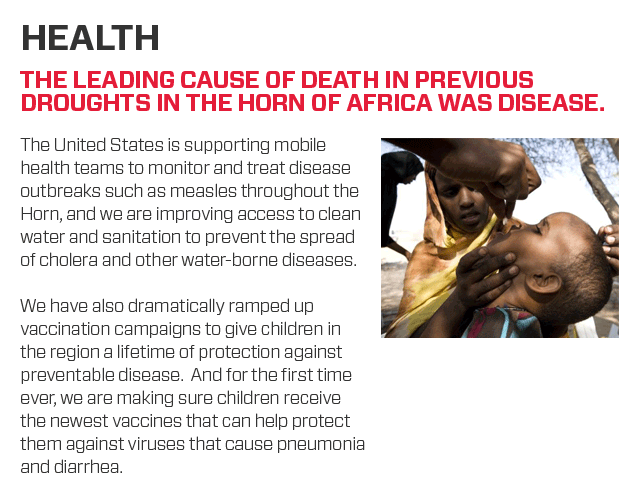
The United States is supporting mobile health teams to monitor and treat disease outbreaks such as measles throughout the Horn, and we are improving access to clean water and sanitation to prevent the spread of cholera and other water-borne diseases.
We have also dramatically ramped up vaccination campaigns to give children in the region a lifetime of protection against preventable disease. And for the first time ever, we are making sure children receive the newest vaccines that can help protect them against viruses that cause pneumonia and diarrhea.
|
|
|
|
|
|
Assistance to Refugees
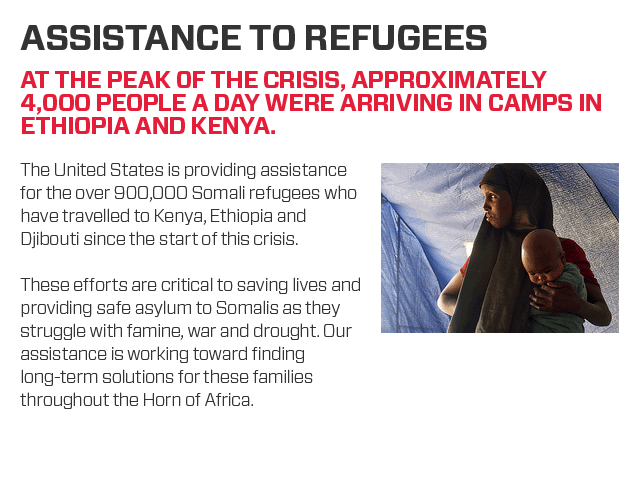
At the peak of the crisis, approximately 4,000 people a day were arriving in camps in Ethiopia and Kenya.
The United States is providing assistance for the over 900,000 Somali refugees who have travelled to Kenya, Ethiopia and Djibouti since the start of this crisis.
These efforts are critical to saving lives and providing safe asylum to Somalis as they struggle with famine, war and drought. Our assistance is working toward finding long-term solutions for these families throughout the Horn of Africa.
|
|
|
|
|
|
Economic Opportunity
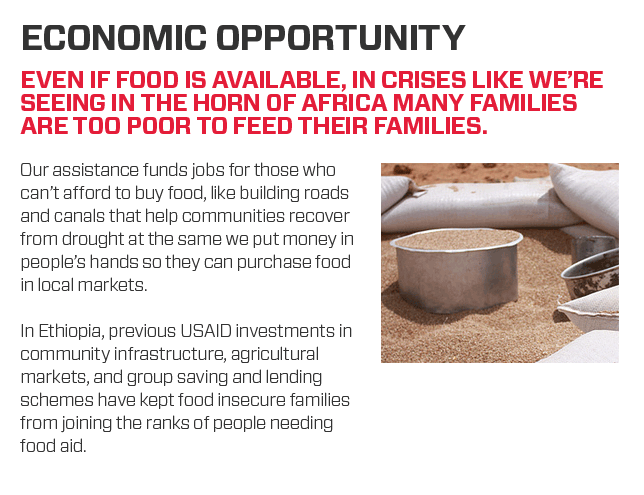
Even if food is available, in crises like we're seeing in the Horn of Africa many families are too poor to feed their families.
Our assistance funds jobs for those who can't afford to buy food, like building roads and canals that help communities recover from drought at the same we put money in people's hands so they can purchase food in local markets.
In Ethiopia, previous USAID investments in community infrastructure, agricultural markets, and group saving and lending schemes have kept food insecure families from joining the ranks of people needing food aid.
|
|
|
|
|
|
Healthy Livestock
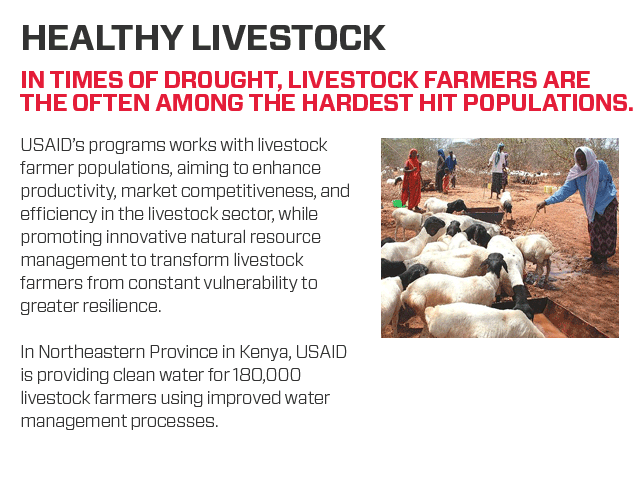
In times of drought, livestock farmers are the often among the hardest hit populations.
USAID's programs works with livestock farmer populations, aiming to enhance productivity, market competitiveness, and efficiency in the livestock sector, while promoting innovative natural resource management to transform livestock farmers from constant vulnerability to greater resilience.
In Northeastern Province in Kenya, USAID is providing clean water for 180,000 livestock farmers using improved water management processes.
|
|
|
|
|
|
|
|
|
|
|
Featured Partners: CARE, CHF International, International Medical Corps, Oxfam America
|
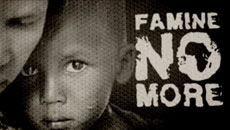
Without additional help, 250,000 are at risk of dying in the Horn of Africa before this crisis is over.
USAID is providing families with emergency food supplies today and, through President Obama's Feed the Future initiative, helping countries invest in agriculture to prevent the food crises of tomorrow.
In Kenya, Ethiopia and stable areas of northern Somalia, life-saving food aid is reaching families. But in southern Somalia, where control by terrorist groups, instability, and violence prevent us from reaching hungry families, we're using vouchers to enable people to buy food on the local market, and thus giving them a lifeline.
And because we've learned that the leading cause of death during famine is disease, not hunger, we're providing care to sick children and vaccinating them against preventable disease.
The U.S. will continue to lead the humanitarian response in the Horn. But the people in the midst of this crisis still need your help. Join us.
Click here to read USAID's most recent Horn of Africa fact sheet (pdf, 402kb)